




New habits to improve your Pelvic floor
Who needs to know about their Pelvic Floor?
Everyone! A man’s pelvic floor supports their bladder and bowel whereas a woman’s pelvic floor supports their bladder, bowel and uterus.
Pelvic floor muscles can be too weak or they can be too tight, this can cause various types of symptoms. People can experience pain in their hips, lower back, tailbone, vagina or perineum (the area between the vagina or penis and the rectum). Training the pelvic floor has many benefits, it can improve bladder or bowel control, increasing social confidence and quality of life. A strong Pelvic floor can reduce the risk of prolapse and improve recovery after childbirth or prostate surgery. It has also been known to improve sexual function for both men and women.
What is your Pelvic Floor?
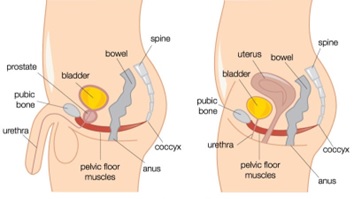
Your pelvic floor is a group of muscles that make up the base of your ‘core’. Looking at the diagram above you can see the pelvic floor muscles extend from your pubic bone to your coccyx (or ‘tailbone’). Like a hammock, they sweep through your pelvis surrounding the vagina or penis and rectum.
Tightening your pelvic floor lifts up the internal organs of the pelvis and relaxing the pelvic floor gives you the control to release urine and feces. Pelvic floor muscles are especially important if your anal or urethral sphincters are not working like normal, this can be the case after childbirth or prostate surgery.
How do I train my pelvic floor?
Pelvic floor training can be split into two parts; relaxing and strengthening.
Relaxing
Start in a quiet environment, sitting comfortably and practice diaphragmatic breathing. Gently allow your belly and ribs to flare out to the side. As you breathe in, allow your pelvic floor to open and relax. As you breathe out, let your belly, diaphragm and pelvic floor fall. Repeat this practice with 5 long and gentle diaphragmatic breaths.
Inhale for 3 to 5 seconds and then hold for 1 second
Exhale for 3-5 seconds and then hold for 1 second
Repeat gently and slowly.
Strengthening
There are two basic strength practices you can try at home. The first is to hold a contraction while completing diaphragmatic breathing. The second is to practice short quick contractions, this is to help prevent sudden leakage.
When starting, make sure you’re in a comfortable position either seated or lying down. Visualize where the muscles are, this can be done by imagining that you’re trying to stop yourself from passing urine or wind at the same time. Avoid squeezing your thighs, buttocks or tummy as these are a different set of muscles.
The first exercise is a 10 second hold, scooping up the muscles of your pelvic floor, you will start to feel a contraction from the very front of your pelvic floor all the way to the back. Breathe out to contract and hold the contraction as you continue to gently breathe in and out. Be kind to yourself, at first you may only be able to hold the contraction for 2-3 seconds, but over time you can increase endurance and aim to hold for 10 seconds. Make sure you completely relax between contractions and rest before repeating the practice.
The second exercise is a set of 10 quick contractions, holding each contraction for approximately 1 second. Continue with gentle breathing and avoid contracting your thighs, buttocks or tummy muscles. Ensure you fully relax the pelvic floor and rest before completing another set of 10. When you start it may be challenging to reach 10 contractions, if that’s the case start with 3 and slowly build up from there.
There are many analogies to help visualize the pelvic floor contracting, here is one that might help;
‘Imagine you’re on ‘I’m a Celebrity, Get Me Out of Here’, they have put you on a time trial, in a box full of ants. Now scoop up your pelvic floor and hold to prevent the ants in your pants from going anywhere you don’t want them to go’,
Finding an analogy that works for you is an ideal way to start training your pelvic floor. If you are experiencing problems with your bladder or bowel control, it is important to be properly assessed, as a weak pelvic floor is only one of the many causes of incontinence. These types of exercises should become a part of your daily routine and it is recommended they’re practiced two to three times per day. The joy of Pelvic floor exercises is that they are invisible to everyone around you, which means you can complete them anywhere, at any time and no one will know. It is good to start sitting or lying down, but as you improve you can complete them while standing or walking.
References:
Cho ST, Kim KH. Pelvic floor muscle exercise and training for coping with urinary incontinence. J Exerc Rehabil. 2021 Dec 27;17(6):379-387. doi: 10.12965/jer.2142666.333. PMID: 35036386; PMCID: PMC8743604.
Continence Foundation of Australia, Continence Health Pelvic Floor, accessed 15.02.23 https://www.continence.org.au/
Radzimińska A, Strączyńska A, Weber-Rajek M, Styczyńska H, Strojek K, Piekorz Z. The impact of pelvic floor muscle training on the quality of life of women with urinary incontinence: a systematic literature review. Clin Interv Aging. 2018 May 17;13:957-965. doi: 10.2147/CIA.S160057. PMID: 29844662; PMCID: PMC5962309.
Sorry, the comment form is closed at this time.