



The FIFA 11+ Program Part 1
Continuing on from our series on the FIFA 11+
So first, let’s look at the basic building blocks behind injury prevention.
Step 1:
Identify the most common mechanisms behind footballing injuries.
Particular weight is given to the injuries that may be preventable, require longer periods of rehab, and have a high rate of recurrence. In regards to lower limb injuries in football, the ACL rupture is the classic example of this. This usually occurs during sudden changes of direction, pivoting, or landing unevenly.

The diagrams detail two common injury mechanisms for the ACL:
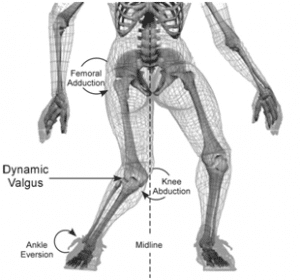
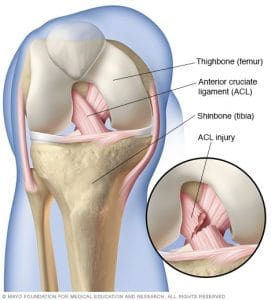
Take note of the amount of twisting at the knee joint due to the lack of control at the hip and ankle over a fixed foot. This particular direction of force tensions the ACL to it’s limit, while the torsion applies a shear force that takes the ligament beyond it’s limit.
Video analysis of a simple running and cutting movement, or hopping and landing, will identify if players display this pattern. Once identified, we can move onto step 2.
Step 2:
Change the factors that lead to the injury mechanism.
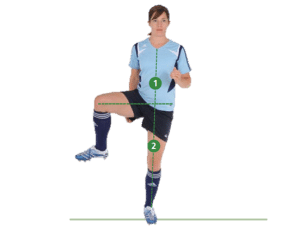
Research has shown that we can retrain the movement patterns and awareness of an athlete to reduce the loading through the ACL in change of direction movements. Firstly, improve awareness of lumbopelvic control and how it applies to key skills in football. Control starts from the trunk and pelvis. The diagrams below show how the correct training of hip and knee control translate into safer running and change of direction motion while playing.
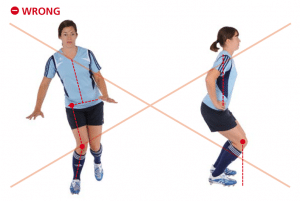
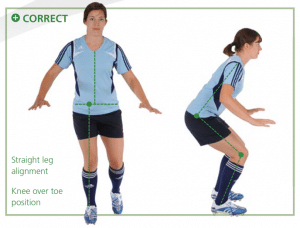
The key is to train the right pattern and gradually apply it into your normal technique until it becomes second nature. This can be tedious at the start, as it requires slow, purposeful movement with attention given to the finer details.
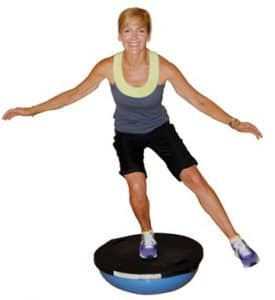
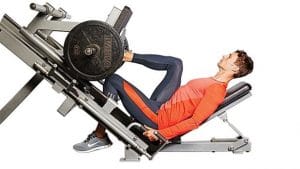
Secondly, isolate points of weakness that fatigue quicker and so would be more susceptible to failing when tired.
The common points of this are:
- Hip abductors and rotators
- Hip extensors
- Quadriceps

Step 3:
Maintain and progress over a sustained period of time
Pre-season is the ideal time to heavily train the correct techniques and build endurance into muscles. Once the season starts, it is recommended to gradually taper off and only have 1-2 short sessions integrated into regular training, which is where the FIFA 11+ program comes in.
If the player suffers any minor injuries to the lower limbs, such as bruises and minor strains/sprains, then they should be reassessed via video analysis to see if their movement pattern has been affected, as in Step 1.
Next week, we will begin working through the FIFA 11+ stages, starting with Part 2: Running Exercises.
Sources:
- http://f-marc.com/fifa-11-plus
- Lippert, L. (2011). Clinical kinesiology and anatomy (5th ed.). Philadelphia, PA: F.A. Davis
- Various images obtained via Google Images for educational purposes.
Sorry, the comment form is closed at this time.