



The FIFA 11+ Program Part 3
Strength, Plyometrics and Balance Exercises
The second section dives in to the real nuts and bolts of injury prevention: boring, slow, repetitive exercises that focus on quality and control of movement, rather than counting reps and sets. This section is only completed at training.
Sounds enticing, I know, but this is the crucial section that can establish excellent habits and raise the neuromotor IQ in the athlete.
As before, each exercise is detailed with pictures of correct technique, a desired number of reps/sets, and video tutorials available online. Each group of exercises have 3 progression levels that provide increasing difficulty and apply each skill into a dynamic movement.
The bench, commonly known as planking
- Static
- Lifting one leg at a time
Sideways bench
- Static
- Dropping the hip down, and raising back up
- Static with raising top leg up and down
Eccentric hamstring exercise
- Beginner – 3-5 reps
- Intermediate – 7-10 reps
- Advanced – 12-15 reps
Single leg (SL) stance/balance
- Hold a ball out in front. Can pass it around body for progression
- Throwing and catching with a partner
- Two players, holding SL stance, pushing and pulling the other to test out their balance
Squats
- Squats with calf raises
- Walking lunges
- SL squats with a partner
Jumping
- DL vertical jumps
- SL sideways jumps from one foot to the other, about 1m
- Multi-directional tuck/box jumps over a cross on the ground
All players should begin on the first level, and progress when the exercise can be performed without difficulty for the specified duration and number of repetitions. Naturally some players may progress a bit quicker in some exercises, while others will take more time.
There are three options:
- Ideally, progression to the next level is determined individually for each player
- Alternatively, all players can progress to the next level for some exercises but continue with the current level for other exercises
- For simplicity, all players can progress to the next level of all exercises after three or four weeks
Finding the right balance is up to the coaching staff to best accommodate the whole team. When focussing on technique and control, it is important to encourage constructive internal and external feedback mechanisms within the players and team. The coaching staff will not be able to individually supervise each player while still finding time to complete the rest of a training session.
Let’s work through an example.
SL stance while throwing and catching a ball.

This exercise is designed to mimic the loading segment in the stance phase of running, while concentrating on an external factor, such as an approaching pass or opponent.
It is from this position that many non-contact lower limb injuries occur, as the player goes to change direction or pivot on the stationary leg.
The numbers break down key focus areas:
- Maintain hip, knee, and ankle alignment in the forward direction (sagittal plane)
- Knee and hip slightly flexed in a ¼ squat position. Note the even balance of weight keeping the head in line with the foot
- Foot planted firmly, weight on balls of foot
- Torso kept straight
- Pelvis level, and not hitching. This complements number 1 and 4
The ‘wrong’ example shows common mechanisms that can be associated with increased risk of injury.
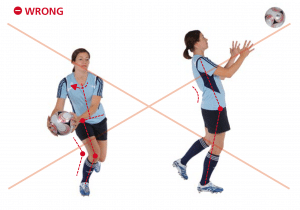
Take particular note of how the knee is twisting into the opposite direction of the torso.
Natural variation in movement is something to be celebrated, so the goal is not to get players to conform to a single pattern of motion. Instead, it is to build awareness and control of how they move, which gives the brain a chance to detect when something is going wrong as early as possible.
Make sure you look out for part 4 in the next blog.
Sources:
http://f-marc.com/fifa-11-plus/
Sorry, the comment form is closed at this time.