



Loading Part 2
Following on from our last post about loading, and in particular how tendons react to overload, let’s look at a few examples of different cases of tendinopathy.
Case A:
A 34 year old male, let’s call him Colin, is convinced by his friends to come and play in a social 5-a-side football match on Astroturf. He runs regularly and considers himself fairly fit, and he used to play club football as a teenager. During the game, he feels fine, his touch is a bit rusty, but settles into it well. His calves feel a little tight after, but he usually experiences this after running as well.
The next morning, he gets out of bed and feels an intense stiffness and pain in the back of his heels. He finds himself limping for 2 minutes until the pain gradually subsides and he feels he can walk normally again. However, throughout the day or two, he gets the same feeling whenever he stands up after sitting or laying for a while. He decides not to go for his usual run for a few days. The pain gradually subsides and he is back to normal and running by the next week.
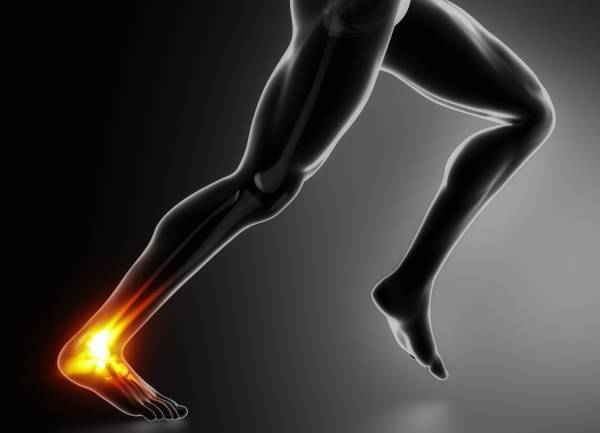
So what happened to Colin’s heels?
On face value, Colin’s pain sounds like a case of reactive tendinopathy in his Achilles tendon. If we refer to the chart on tendon loading (see below), we can characterise Colin’s normal tendon loading as his usual day to day activity and running. As he improves with his running distance and speed, we would see a corresponding adaptation in his lower limb tendons to optimise his performance.
However, when Colin played the 30-40 mins of social football with his friends, he introduced an unfamiliar type of loading to his legs. To further break this down, let’s make a list of the differences in loading forces:
Running
- Straight line movement
- Cope with changes in terrain and gradient
- Footwear optimised for running
- Consistent impact loading pattern – Variable with speed and terrain
Football
- Multi-directional
- Uniform terrain and level surface
- Footwear optimised for grip and control
- Highly variable impact forces – Kicking, tackling, jumping
These differences were enough to irritate the Achilles tendon, and cause a reaction similar to inflammation. Referring to our previous blog on loading: “the tendon swells in the injured area, and becomes very sensitive, which is termed a reactive tendinopathy.” The nerve endings that sense pain, along with the stretch receptor cells, become more sensitive to input. This tends to increase pain and tenderness.
This stage usually most active for 2-3 days following injury, and responds well to decreasing the loading experienced by the tendon, which is exactly what Colin did. He went about his usual daily activity, but did not run that week.
Let’s say, instead, he took a week off work and lay in bed to rest his feet. He avoided as much activity on his feet as possible, and used crutches to support himself with his arms. The reaction in the tendon would still settle, but as soon as he tried to run again, it is likely he would re-aggravate the tendon and be back to square one. This is due to him shielding the tendon from a moderate amount of stress that helps guide the healing process back to a normal tendon. We use the term “stress shielded” to describe this process.
Another alternative would be that Colin did not rest at all, and instead decided to run each day while his tendon was aggravated. Given his usual training, it is likely he would feel okay once he had warmed up during the run. However, the reactive state of the tendon makes it likely to aggravate further and become steadily worse, as it is not given a chance to resolve.
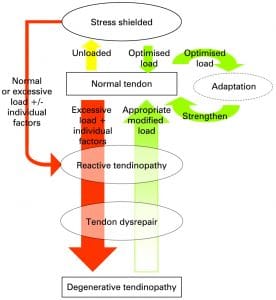
If this continues, the tendon may become stuck in a cycle of disrepair, where it is constantly attempting to heal, but without successfully remodelling the tendon tissue to return to its normal function. If we looked under a microscope, we would see a disorganised jumble of tendon fibres, instead of the tightly organised, unidirectional cable that it should be. The body may even attempt to increase the blood flow to the inside of the tendon, with small blood vessels infiltrating through the tissue, further weakening the structure of the tissue.
The more dysrepair within the tendon, the longer it will take to heal. Also, the risk of tissue failure increases, which leads to tears and possible rupture, depending on the extent of damage.
The take home message with these scenarios is that identifying the activity that initially aggravated the tendon is crucial in managing this type of injury. Modifying it appropriately will lead to good recovery, whereas abusing the injury will likely make it worse.
Sources:
Cook, J L, & Purdam, C R. (2009). Is tendon pathology a continuum? A pathology model to explain the clinical presentation of load-induced tendinopathy. British Journal of Sports Medicine, 43(6), 409-416. doi: 10.1136/bjsm.2008.051193
Sorry, the comment form is closed at this time.