



Loading
“I have no idea how it started. I just woke up one morning and it was there.”
This vague and generic response is one of the most common things we hear from our clients when we ask how they think their pain started.
We’ve all been there. The other day I woke up with a stiff and sore neck. While I struggled down the hallway to get to the kettle for my coffee ritual, I tried to find an explanation for my pain:
- “maybe I slept funny?”
- “maybe I’m getting old?”
- “maybe I should change my pillow?”
- “maybe I injured it yesterday?”
I didn’t do anything strenuous the day before, all I did was lay on the couch and watch 3 consecutive football matches. Who can deny the allure of football in May? It’s exciting stuff.
Then I realise that maybe laying for about 4 hours with only a few snack breaks probably wasn’t the best idea, and might have something to do with why my neck was sore.
When people think of pain, we usually look for some physical exertion that may have caused an injury. This is can be true for most body parts, such as fracturing a bone or getting a cut on your skin. However, tissues such as muscles, joints and tendons tend to respond differently depending on the type of loading.
Loading is a term used to characterise any type of stress applied to body tissues. Loading tends to be cumulative through periods of activity and is unloaded through periods of rest and recovery. A muscle, for example, is able to sustain a period of normal loading, which is its function of contracting and relaxing to create movement, until it runs out of energy or the neural signals coming to it fatigues. If it continues to work or tries to produce a contraction beyond its limits, then it becomes overloaded and fails. This can occur as an acute mechanism, or gradually build up over a sustained period of loading that leads to fatigue.
In terms of my neck pain, the joints and muscles that move them had to endure a long period of loading in a flexed position that may have gradually overloaded them. In response, my brain would tighten the tone of muscles in the area to limit movement while the joints recovered. If that recovery process takes more than one night’s rest, then I end up with a sore and stiff neck in the morning.
Tendinopathy
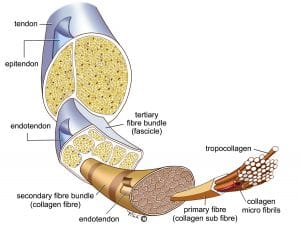 Lower limb tendon tissue is the perfect example of a load-dependent substance. Let’s use the Achilles tendon as a well known example.
With a relatively poor blood supply and high tensile strength, its adaptation process is dependent on external forces that help guide its function and adaptation. This would involve the ground reaction force from the heel striking the ground, and transferring the force of the calf muscles to the heel to push your body weight off the ground.
The picture adjacent depicts the typical structure of a tendon, with the small red dots representing a scattering of small blood vessels. The tendon is also wrapped in a sheath called the paratenon, that has a higher blood supply, and allows nutrients to diffuse into the tendon structure.
This is very different from muscle, which is essentially bathed in blood supply via a high surface area network of blood vessels that form a ‘capillary bed’
The flowchart below (developed by Cook & Purdam, 2009) details how a tendon responds to different amounts of loading. Tendon tissue is a creature of habit, adapting over time to the usual stresses it has to endure during our daily routines.
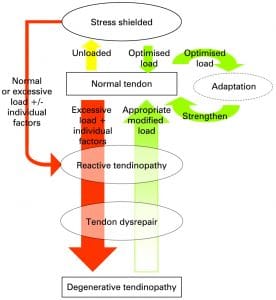 As you can see, a normal tendon will get into trouble if it is subjected to an excessive load that triggers a healing mechanism somewhat similar to an inflammatory response.
The tendon swells in the injured area, and becomes very sensitive, which is termed a reactive tendinopathy.
An example would be a normally sedentary person suddenly going out for a 60 min run. Or, on the other end of the spectrum, a marathon runner completing a race in different shoes than he is used to.
If the excessive loading is identified quickly, then it can be modified to allow the tendon to return to normal.
However, if the excessive loading continues faster than the rate of repair, then the body will attempt to accelerate it by switching protein producing cells into overdrive and start to form new blood vessels to infiltrate the tendon tissue. This process is termed tendon dysrepair as the increased production of proteins causes disorganisation of the tightly bundled tendon fibres, and leads to a weaker structure.
Continued insult may even lead to degenerative changes within the tendon, which essentially means that the injured segments of the tissue break down and begin to die. If enough of the tendon structure reaches the stage of degenerative tendinopathy, it may reach a point of failure and rupture, although this is a rare injury.
In the Achilles tendon, this causes retraction of the tendon, due to the high amount of tension. At which point, the only solution we currently have is surgery and a very long period of slow rehabilitation.
We do have to make one disclaimer: Degenerative changes within tendon can be a normal ageing process, as with any other body tissue. This means that the overall capacity of a tendon does naturally decrease over time. However, as mentioned before, the adaptation within a tendon is dependent on your daily amount of loading, which is why maintaining strength and good function over a long period of time helps reduce your risk of injury.
Anyway, that’s enough of an anatomy lesson for today. We’ll carry on with the topic of loading next time. In particular, we’ll look at some real life examples of tendon loading injuries, and how we go about resolving them.
Sources:
Cook, J L, & Purdam, C R. (2009). Is tendon pathology a continuum? A pathology model to explain the clinical presentation of load-induced tendinopathy. British Journal of Sports Medicine, 43(6), 409-416. doi: 10.1136/bjsm.2008.051193
Sorry, the comment form is closed at this time.